
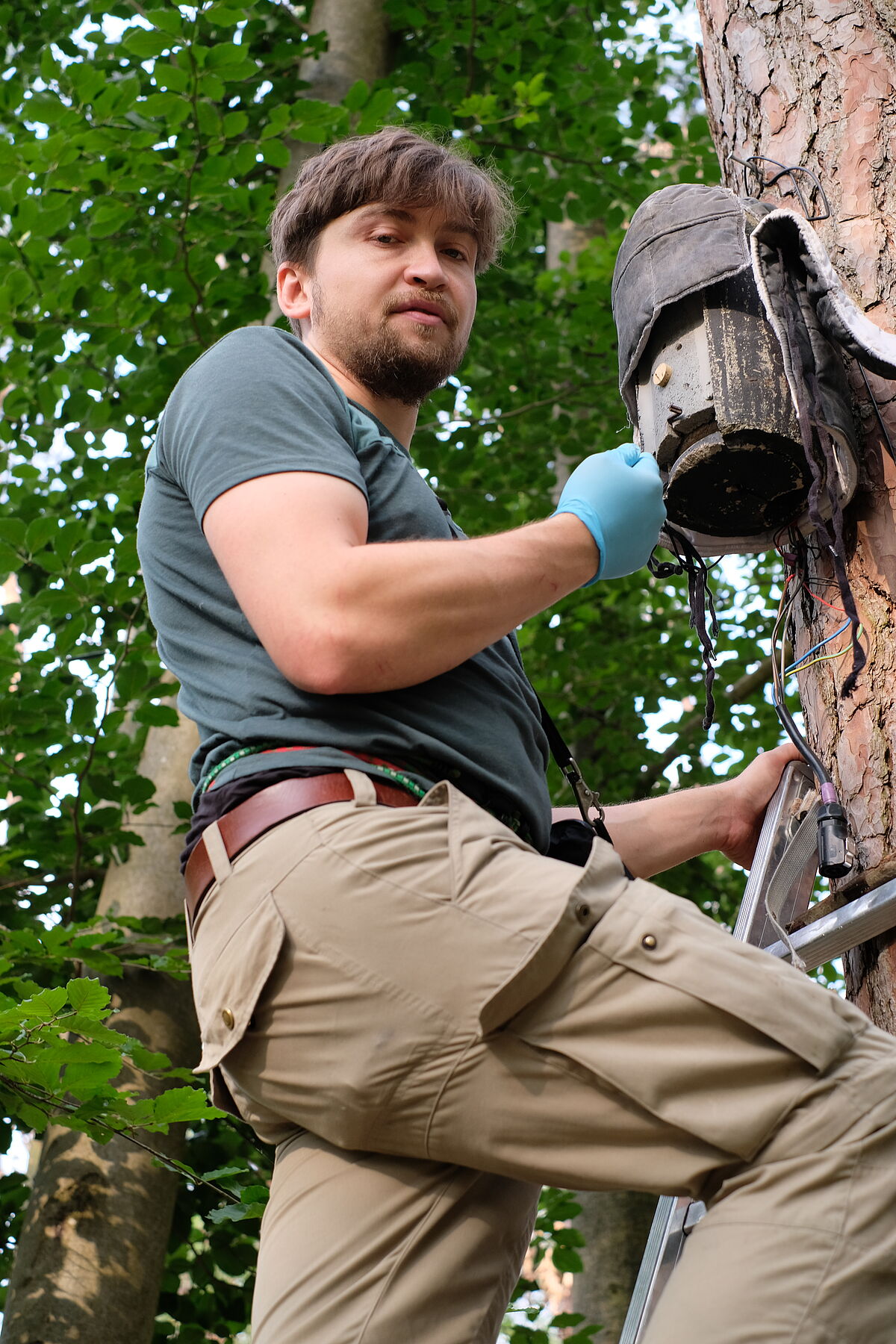
Dr. Janis Wolf
Applied Zoology and Nature Conservation
Loitzer Str. 26
17489 Greifswald
Tel.: +49 (0)3834 420-4273
Fax: +49 (0)3834 420-4252
janis.wolf(at)uni-greifswald(dot)de
Habitat conservation for forest bats under climate change
Currently, I am part of the collaborative project Lebensraumschutz für windkraftsensible Waldfledermäuse (Habitat conservation for forest bats sensitive to wind turbines) funded by the Bundesamt für Naturschutz (BfN) within the National Species Recovery Programme (Nationales Artenhilfsprogramm; nAHP). The project is a follow-up to the Barbastelle bat project, in which the University of Greifswald was a project partner from 2018 to 2024.
My work in this project focuses on the habitat conservation of forest bats with regard to the expected impacts of climate change on suitable habitats, taking into account the effects of global warming on the animals themselves. To support the long-term effectiveness of conservation measures, we use a range of modelling approaches to produce projections of habitat suitability and connectivity under different climate change scenarios for four characteristic forest bat species: Barbastelle bat (Barbastella barbastellus), Bechstein’s bat (Myotis bechsteinii), Leisler’s bat (Nyctalus leisleri) and Nathusius’ pipistrelle (Pipistrellus nathusii).
Physiological responses of bats to climate change
During my PhD, I investigated the physiological responses of Bechstein’s bats (Myotis bechsteinii) to global warming. Combining field experiments with long-term data from several maternity colonies in southern Germany, we found that higher temperatures are associated with larger body sizes, likely due to reduced thermoregulatory costs and, consequently, increased maternal care during the postnatal growth phase (Mundinger & Wolf et al. 2022; Wolf & Kerth 2024). Our research further suggests that Bechstein’s bats, and likely other temperate-zone species, are overall well adapted to colder conditions but may be less able to tolerate extreme heat (Wolf et al. 2025).
Urbanisation and invasive species
In addition to studying the effects of climate change, I am interested in other anthropogenic drivers of biodiversity change. In particular, my research has focused on macroecological approaches and data-driven analyses to assess the effects of urbanisation and the impacts of invasive species.
Publications
§ indicates shared first authorship
- Wolf J.M.§, Kerth G.§ & Chávez F. (2026). Roosting Requirements of Temperate Zone Forest Bats in a Warming World: Weather Predicts Bat Box Use in Bechstein’s Bats. Forest Ecology and Management 621: 124232. https://doi.org/10.1016/j.foreco.2026.124232
- Hernández-Montero J.R., Wolf J.M., Chávez F., Mayer F. & Kerth G. (2026). Determining Activity Patterns and Home Range of Wild Bats Using a Proximity Biologging System Based on the Internet of Things (IoT). Ecology and Evolution 16(5): e73604. https://doi.org/10.1002/ece3.73604
- Kerth G.§ & Wolf J.M.§ (2025). In-situ responses of temperate-zone bats to climate change. Annals of the New York Academy of Sciences 1546: 23–34. https://doi.org/10.1111/nyas.15317
- Wolf J.M., Lehmann P. & Kerth G. (2025). Field respirometry in a wild maternity colony of Bechstein's bats (Myotis bechsteinii) indicates high metabolic costs above but not below the thermoneutral zone. Journal of Experimental Biology 228(2): jeb.249975. https://doi.org/10.1242/jeb.249975.
- Wolf J.M. & Kerth G. (2024). Optimally warm roost temperatures during lactation do not improve body condition in a long-lived bat. Biology Letters 20(10): 20240346. https://doi.org/10.1098/rsbl.2024.0346.
- Mundinger C.§, Wolf J.M.§, Gogarten J.F., Fierz M., Scheuerlein A. & Kerth G. (2023). Artificially raised roost temperatures lead to larger body sizes in wild bats. Current Biology 33. https://doi.org/10.1016/j.cub.2023.08.004.
- Wolf J.M., Jeschke J.M., Voigt C.C. & Itescu Y. (2022). Urban affinity and its associated traits: A global analysis of bats. Global Change Biology 28: 5667–5682. https://doi.org/10.1111/gcb.16320.
- Wolf J.M., Haase D. & Kühn I. (2020). The functional composition of the neophytic flora changes in response to environmental conditions along a rural-urban gradient. NeoBiota 54: 23–47. https://doi.org/10.3897/neobiota.54.38898.
- Kühn I., Wolf J.M. & Schneider A. (2017). Is there an urban effect in alien plant invasions? Biological Invasions 19: 3505–3513. https://doi.org/10.1007/s10530-017-1591-1.